
GPS 122 — Tolerance Zones
Available at iso-gps.com ↗. List price US$ 99.
Prerequisites: GPS 120 and GPS 121.
Course Topics
- Introduction — the role of tolerance zones in GPS
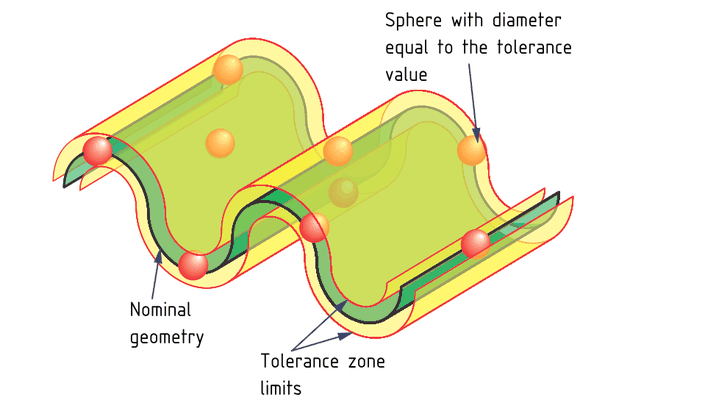
- 3D tolerance zones bounded by surfaces:
- Two parallel planes
- Cylinder
- Sphere
- Free-form surface
- Two coaxial cylinders
- 2D tolerance zones bounded by lines in identified cross-sections:
- Pairs of straight lines
- Pairs of circles
- Pairs of parallel lines
- One pair of straight lines
- One circle
- Tolerance zone constraints (three parts)
Course Description
Tolerance zones are the building blocks of geometrical tolerancing. Every geometrical tolerance defines a zone — a region of space bounded by surfaces or lines — that the toleranced feature must lie within. Understanding the different shapes a tolerance zone can take, and how constraints limit its ability to move, is essential for reading and writing GPS specifications correctly.
The course covers all the tolerance zone geometries used in ISO 1101, from the most common (two parallel planes, cylinder) to the more specialised (sphere, free-form surface, sets of 2D zones). For each zone type, the course shows what the zone looks like and what degrees of freedom it leaves free.
The second part of the course covers tolerance zone constraints: how you can restrict the movement of a tolerance zone by locking specific degrees of freedom, using references to datums and datum systems. This is what allows the tolerance zone to be placed in a defined position and orientation relative to the component.
Learning Goals
Upon completing this course you will be able to:
- Identify the different shapes geometrical tolerance zones can take.
- Understand the difference between 3D zones, 2D zones, and infinite sets of 2D zones.
- Determine which degrees of freedom a given tolerance zone leaves free.
- Apply constraints to a tolerance zone to lock specific degrees of freedom.
- Specify precise requirements using multiple constrained tolerance zones.
This course is intended for engineers, metrologists, and quality professionals who need a thorough understanding of geometrical tolerance zones in order to apply and interpret GPS specifications correctly.