
GPS 121 — Degrees of Freedom Analysis
Available free at iso-gps.com ↗.
Prerequisite: GPS 120 — Introduction to Geometrical Tolerancing.
Course Topics
- Introduction — coordinates in space
- A cylindrical tolerance zone
- A planar tolerance zone
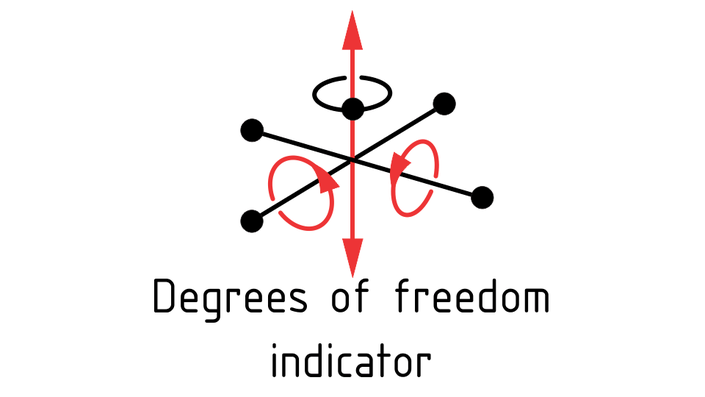
- The Degrees of Freedom indicator (two parts)
- Diameters as degrees of freedom
- Intrinsic degrees of freedom
- Degrees of freedom for datum systems
- Adding constraints to tolerance zones
Course Description
This course introduces a structured way of looking at geometrical tolerances: the Degrees of Freedom (DoF) indicator. The DoF indicator is a visual tool that makes it easy to analyse how a particular tolerance zone constrains the toleranced feature — whether it controls shape, orientation, location, or some combination of these.
For any geometrical tolerance, you can determine which degrees of freedom the tolerance zone locks and which it leaves free. This is the foundation for selecting the right tolerance symbol and datum references when specifying a component.
The course covers both the indicator itself and its application to cylindrical and planar tolerance zones, datum systems, and constrained tolerance zones. It is a bridge course between GPS 120 and the more detailed GPS 122 and GPS 123.
Learning Goals
Upon completing this course you will be able to:
- Use the Degrees of Freedom indicator to analyse any geometrical tolerance.
- Determine which degrees of freedom a given tolerance zone locks.
- Understand how datum systems constrain degrees of freedom.
- Decide which tolerance symbols and datum references to use based on what needs to be constrained.
This course is intended for anyone working with geometrical product specifications who wants a more systematic approach to reading and writing geometrical tolerances.